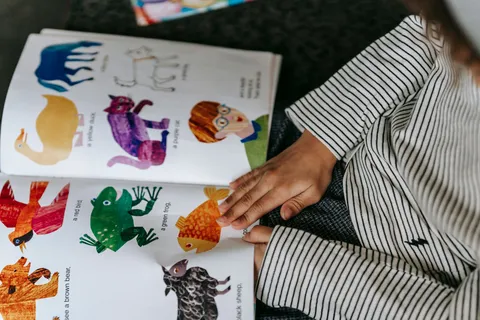
Your child knows a handful of words, can sound out a few letters and is starting to ask “What does this say?” on cereal boxes. The next question is how to move from single words to real sentences without turning reading into a battle.
The good news is that reading a sentence is a skill you can build in small, friendly steps. This guide shows a simple step ladder for teaching a child to read simple sentences at home, with routines, ways to correct mistakes kindly and signs that it may be time to ask a teacher for advice.
Before you start: what your child needs
Sentence reading usually goes more smoothly when a few foundations are in place. You do not need all of them to be perfect, but they help:
- Letter knowledge. Your child recognizes most letters and knows their common sounds.
- A small bank of sight words. These are very common words such as the, is, and, to, a, it, we, my that children learn to recognize quickly. Our guide to how to teach sight words to kindergarteners covers ways to build this bank.
- Left-to-right habits. Your child understands that we read from left to right, top to bottom, and that spaces separate words.
- Joy in stories. Children who love books tend to try harder with the tricky parts. Keep reading aloud every day; the benefits of reading aloud do not stop when your child starts decoding.
If those pieces are still wobbly, spend more time there first. Starting sentences too early can feel discouraging.
The step ladder
Think of reading sentences as a ladder with small rungs. Stay on each rung until your child feels comfortable, then move up. Some children climb in a week and some take months. Both are fine.
Rung 1: Know a few words by sight
Aim for a small set of words that appear in many sentences. Practice with flash cards, a quick hunt through a page or a game of “find the word.” Short, frequent practice works best, about five minutes at a time.
Rung 2: Read a two-word phrase
Combine two known words: I can, we go, it is. Write the phrase on a card, point under each word and let your child read it. Then mix and match: I can, we can, I go. This shows that words can slide into new combinations.
Rung 3: Read a short sentence
Add one more word to make a full thought: I can go. Point out the capital letter at the start and the period at the end (“The period tells us to stop”). Keep sentences to three or four words at first.
Rung 4: Add a picture clue
Draw or choose a simple picture to go with the sentence: a stick figure running above I can run. Pictures give children a bit of meaning to lean on and make the effort feel worthwhile. Over time, reduce the clues and let the words do the work.
Rung 5: Read two sentences in a row
Link two short sentences: I see a dog. The dog can run. Ask a quick question afterward: “Who can run?” This reminds children that reading is about meaning, not just saying words aloud.
Rung 6: Move to simple books
Choose books with large print, few words per page and repeated patterns. Take turns: you read one page and your child reads the next, or your child reads the repeated line while you read the rest.
A 10-minute daily routine
Here is a relaxed routine that fits most evenings:
- Warm up (2 minutes). Review three or four known words on cards.
- Build (3 minutes). Make a new phrase or sentence with word cards on the floor and read it together.
- Read (3 minutes). Your child reads one or two sentences from the day’s rung, pointing to each word.
- Finish with a story (2 minutes or more). You read a picture book aloud. Enjoyment is the goal.
Keep a small “I can read” box or jar and add the sentences your child reads that week. Rereading old sentences builds confidence.
How to correct mistakes gently
Mistakes are part of learning. A kind correction routine keeps the mood light:
- Wait. Give a few seconds before jumping in. Children often fix errors themselves.
- Point to the word. Slide your finger under it and say, “Look at this word again.”
- Give a clue. “What sound does it start with?” or “Look at the picture.”
- Say it together. If the word is still stuck, say it with your child, then read the sentence again from the start.
- Praise effort. “You looked closely at that word.” Praising effort tells children what to repeat.
Avoid saying “No, that’s wrong” or sighing; children notice tone quickly. If a particular word keeps causing trouble, add it to your card pile and revisit it in a few days.
Making practice playful
Variety keeps sessions fresh:
- Sentence scramble. Write each word of a sentence on a separate card, mix them up and let your child put them in order.
- Silly sentences. Swap one word to make a funny sentence: I can jump becomes I can nap. Giggles are good for memory.
- Sentence hunt. Hide sentence strips around the room. Your child finds one, reads it and acts it out.
- Highlighter hunt. Give your child a page from a book and ask them to find and color every the.
- Reading buddy. Let your child read to a stuffed animal or pet. Many children relax when the listener will not correct them.
Using a printable workbook as support
Some families like having sentence practice already organized on paper. Sight Words in Sentences: Kindergarten & First Grade Workbook is a 25-page printable PDF that covers 24 common sight words, including the, is, and, to, in, a, it, he, she, we, my, you, they, can, are. Its activities include spot the word, trace the word, write the word, read the sentences and color the sight word, with picture-supported sentence practice. It is priced at $3.99 as a downloadable PDF.
If you use it, print a few pages at a time and treat them as one rung in your ladder. The workbook cannot replace reading aloud and talking about stories, but it can give you a ready-made set of exercises when you want structure. It is also a handy way to practice handwriting alongside reading, since children trace and write the words they read.
Reading sentences and handwriting together
Writing a sentence helps lock in the words your child can read. Try these lightweight ideas:
- Write a one-line sentence of the day on a whiteboard: We can go to the park.
- Let your child trace the words, then copy them underneath.
- Ask them to draw a picture to match.
Do not worry about perfect letter shapes. Early writing is about connecting sounds, words and meaning.
When to ask for help
Learning to read happens at different speeds, and a slow start is not in itself a problem. However, it is sensible to talk with your child’s teacher if:
- your child stays very frustrated or upset about reading over a long stretch,
- progress seems to stall despite regular practice,
- you notice your child avoids reading, or has trouble seeing or hearing in everyday life.
A teacher or school specialist can look at your child’s progress, suggest next steps and arrange further checks if needed. Please avoid diagnosing causes yourself; a professional is the right person to do that.
Keep it joyful
The goal of early sentence reading is a child who feels “I can do this.” Keep the ladder in mind, stay on each rung as long as needed, correct kindly and surround practice with stories you enjoy together. Our read-aloud routine at home guide offers simple ways to keep that storytime habit going while your child’s own reading takes off.