Adding and subtracting can feel like a big leap for a five-year-old, but it grows out of something children already do: counting things and noticing when there are more or fewer. With the right order of steps and a bag of ordinary objects, teaching addition and subtraction to kindergarteners can be calm, playful and surprisingly quick.
This guide gives you a practical sequence within 10, the activities that go with each step, the mistakes to expect and how to respond, and a simple way to fit practice into a busy day. Children vary, so treat the steps as a path you can slow down on, not a schedule.
Before you start: check the foundations
Addition and subtraction rest on a few earlier skills. If these are wobbly, spend a little more time here first:
- Counting aloud to 10 in order.
- One-to-one counting: touching each object once while saying one number. Children who count faster than they touch often get the wrong total.
- Knowing the last number tells “how many”. After counting a group, ask “So how many are there?” If your child starts counting again from one, they are still learning this idea.
- Recognizing numerals 1 to 10 and matching them to groups.
A quick check: put out seven blocks in a messy pile and ask your child to count them. If they land on seven and can tell you “there are seven,” you are ready to move on.
Step 1: Join two groups (the idea of adding)
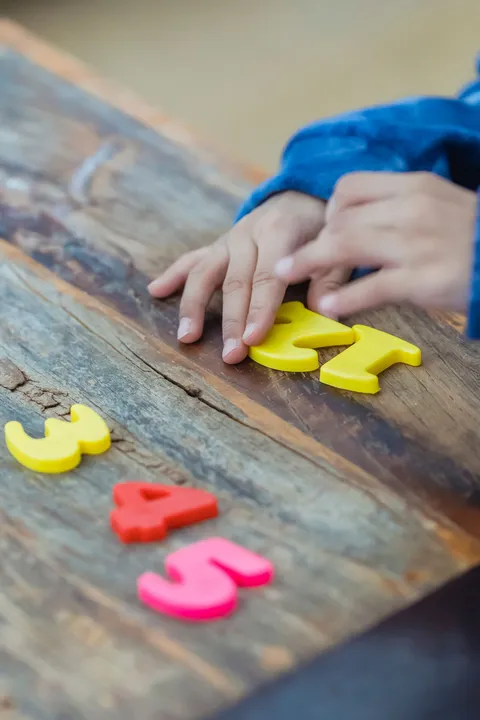
Begin with objects, not numbers on paper. Use blocks, buttons, crackers or small toy animals.
- Put two blocks on the table. Say, “Here are two.”
- Put three more beside them. Say, “Here are three more.”
- Slide them together and ask, “How many altogether?”
- Count them all, one by one, and say the total.
Then say the sentence in words: “Two and three more makes five.” Repeat with different small numbers. At this stage the goal is the idea of putting groups together, not memorizing facts.
A tip: use two different colors, such as red blocks and blue blocks. The colors make the two groups easy to see before they are joined.
Step 2: Add with fingers and “count on”
Once joining groups is comfortable, fingers become a handy tool.
- Hold up three fingers on one hand and two on the other. Count all five.
- Later, encourage “counting on”: start at the larger number and count up. For 4 + 2, say “four… five, six.”
Counting on can take a while to arrive, and many children need weeks of practice with objects first. If your child prefers to count everything from one, that is fine; it still works and speeds up naturally with time.
Step 3: Tell number stories
Stories make math meaningful. Act out little scenes with toys:
- “Three ducks are in the pond. Two more ducks come. How many ducks now?”
- “There are four cookies on the plate. Your sister takes one. How many are left?”
Let your child move the toys. Ask them to explain what happened in their own words. This is where the later words “plus,” “minus” and “equals” gain their meaning.
Step 4: Move from objects to pictures
When your child handles objects easily, switch to drawings. Ask them to draw circles or stick figures for each number and count the total. Picture-based sums, such as two apples plus three apples, bridge the gap between real things and written numerals. Keep the drawings quick and simple so the focus stays on the math.
Step 5: Introduce subtraction as taking away
Subtraction is easiest to understand as “some go away.”
- Put out five objects and count them.
- Say, “Now two go away,” and move two aside, or hide them under a cup.
- Ask, “How many are left?” and let your child count what remains.
- Say the sentence: “Five take away two leaves three.”
Practice the same way as addition: first with objects, then with fingers (fold fingers down), then with pictures where your child crosses out items. Later, introduce the written form 5 - 2 = 3 beside the objects so they connect.
Two ideas for variety: a “disappearing” game, where you hide some objects and your child works out how many are hidden, and snack-time subtraction (“You had six grapes and ate two. How many now?”). If the snack is food, choose a size and type that is safe for your child’s age and supervise.
Step 6: Connect to written number sentences
When children are confident with objects and pictures, show the written form beside what they have just done:
- Place 3 blocks and 2 blocks, then write 3 + 2 = 5.
- Take away from 6 blocks, then write 6 - 2 = 4.
Read the sentence aloud together. Over time, let your child write the numerals themselves. Keep numbers within 10. Staying within 10 throughout kindergarten gives children time to build a strong feel for numbers before they face larger ones.
Common mistakes and how to respond
Counting the same object twice or skipping one. Have your child touch and move each object into a “counted” pile. Moving things makes it hard to count one twice.
Starting again from one every time. This is normal. Keep practicing both ways and gently model counting on. “We already know there are four here. Let’s start from four.”
Adding when the sign says subtract (or the reverse). Point out the sign, say it aloud, and act it out: “Minus means take away. Let’s take two away.”
Guessing without checking. Ask, “Can you show me with your blocks?” so the answer comes from a method, not a hunch.
Getting frustrated. Step back to an easier level. Doing a few easy ones first restores confidence, then you can try one that is slightly harder.
Whenever your child makes a mistake, try replying with “Show me how you worked it out” instead of “No.” You will often see exactly where the thinking went off track, which tells you what to practice.
Short, daily practice that fits real life
Frequent, brief practice usually beats long sessions. Here are some low-effort ideas:
- Stairs and steps. Count them going up and down, and ask “If we climb two more, which step will we be on?”
- Setting the table. “We need four forks and we have two. How many more do we need?”
- Bath or park toys. Add or take away toys in the water or sandbox.
- Dice and card games. Roll two dice and add the dots, or use a deck of cards with the face cards removed.
- Bedtime story math. Count objects in the illustrations and ask simple “how many more?” questions.
Five to ten minutes at a calm moment is plenty. If your child is tired, hungry or restless, leave it for another time.
Using a workbook alongside hands-on play
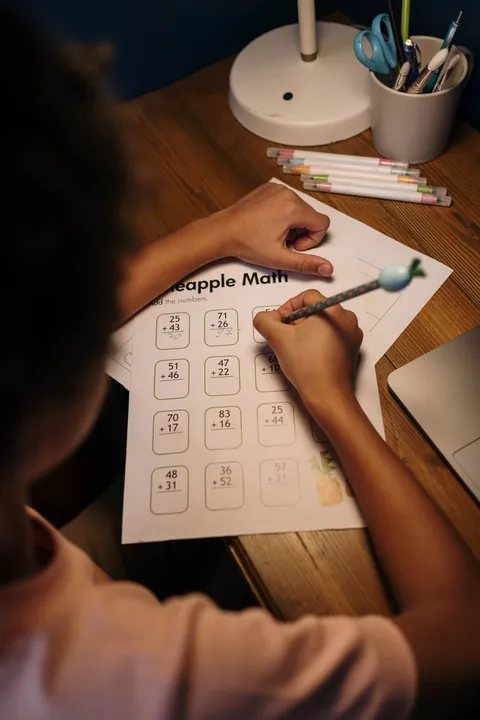
Once your child has done plenty of hands-on work, a workbook gives structured practice with pictures and written sums. The Kindergarten Math Workbook: Counting, Numbers, Addition & Subtraction to 10 is a 25-page printable PDF for ages 5 to 6, with counting, number matching, addition and subtraction on fingers and with pictures, plus puzzles and a final math challenge. It works best as a companion to the objects-and-stories steps above, not a replacement. Print a couple of pages at a time and let your child work with a pencil while you stay close.
For more ideas on what to practice at this age, see our guide to kindergarten math and reading worksheets, the overview of getting ready for kindergarten at home and our article on logic and problem-solving activities, which build the same habit of thinking things through.
When to slow down and when to move on
Move on when your child can do the current step with a little confidence several days in a row, and can explain what they did in their own words. Slow down if they guess often, get upset quickly or lose track of counts. Dropping back a step is not failing; it is how strong foundations are built. If you are worried about your child’s progress, a conversation with their teacher or pediatrician is a sensible next step, since they can see the whole picture.
With real objects, short sessions and plenty of patience, most children find that adding and taking away within 10 becomes second nature. Keep it playful, celebrate the effort, and let the numbers become familiar friends.