Many parents open the school year with the same quiet question: is my child where they should be in math? A kindergarten math skills checklist can help you notice what your child already does well and where a little extra playful practice might help. It is not a test, and it is not a race.
This guide walks through the early math skills most kindergarten programs work on at about ages 5 to 6, with simple ways to practice each one at home. Standards differ between schools and countries, and children develop at different speeds, so use it as a friendly guide rather than a strict benchmark.
How to use this checklist
Read through the skills and mark each one as “not yet”, “sometimes” or “got it”. Most children will be a mix. A child who counts confidently but is shaky with number writing is completely ordinary.
A few ground rules:
- Check skills with real objects first, then with pictures, then with written numbers.
- Stop when your child is tired or frustrated and come back another day.
- Pick one or two skills to focus on at a time rather than working through the whole list.
1. Counting and number sense
Counting is more than reciting numbers. Look for these steps:
- Says the counting words in order, to 10 and then further.
- Counts objects one by one, touching each and saying one number per object.
- Knows the last number said tells how many (the “how many” idea).
- Can count out a requested amount, such as “give me five grapes.”
- Counts forward from a number other than one, such as starting at 4.
Practice at home: count stairs, socks, spoons at the table or steps to the mailbox. Let your child move each item to a “counted” pile so none are skipped or counted twice.
2. Recognizing and writing numbers
- Names the numerals 0 to 10, then beyond.
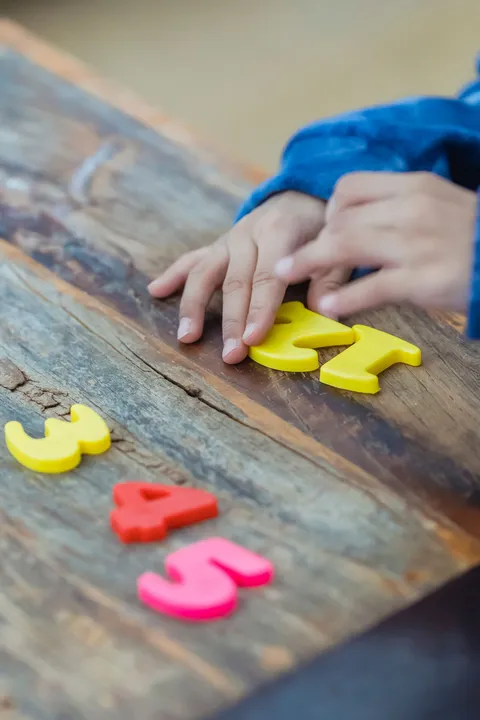
- Matches a numeral to a group of objects (the numeral 4 with four dots).
- Writes numerals, often with some reversals at first, which is very common at this age.
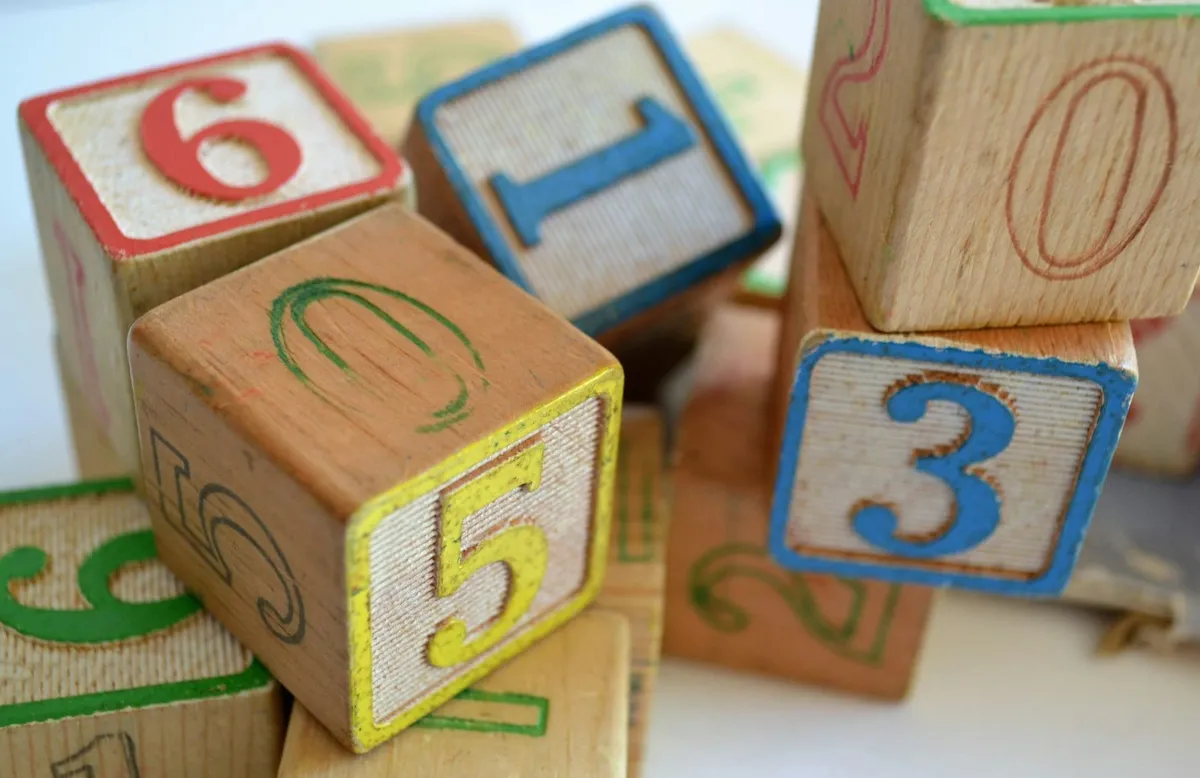
Practice at home: trace big numbers in a tray of salt or sand, build them from playdough ropes, or hunt for numbers on doors, clocks and signs. Number blocks like the ones in the photo above are a handy way to put numbers in a child’s hands.
3. Comparing: more, less and the same
- Looks at two groups and says which has more, fewer or the same.
- Compares sizes: bigger, smaller, longer, shorter.
- Later, begins to meet the greater-than and less-than symbols.
Practice at home: put out two plates with different numbers of berries or crackers and ask “which has more? how do you know?” Line the items up in rows so your child can see the match-up. Let them win a “more” snack sometimes, which makes the idea memorable.
4. Adding and subtracting within 10
At kindergarten level, this usually means putting together and taking apart small groups, not memorized facts.
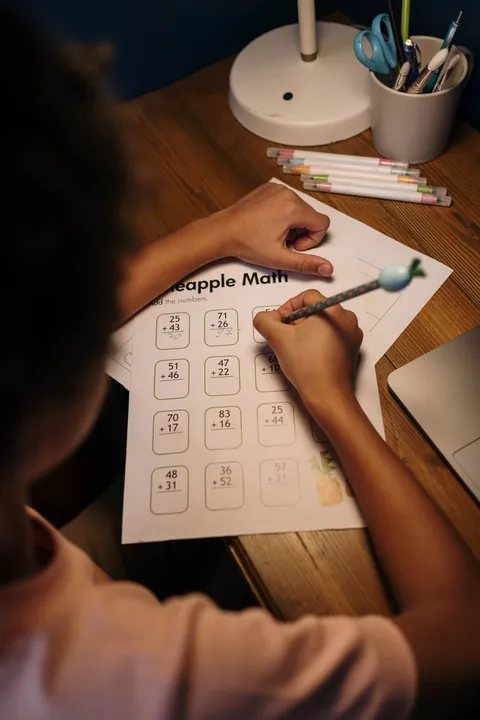
- Adds two small groups using objects, fingers or pictures (“3 apples and 2 apples makes 5 apples”).
- Takes away from a group (“5 cookies, 2 are eaten, 3 are left”).
- Tells simple stories that go with a number sentence.
Practice at home: use blocks, buttons or small toys and act out little stories. Ask your child to make up their own: “I had 4 cars and 1 drove away.” Fingers are a perfectly good tool; there is no need to discourage them.
5. Shapes
- Names common flat shapes such as circle, square, triangle and rectangle.
- Spots shapes in the real world: a clock is a circle, a window is a rectangle.
- Describes shapes in simple terms, such as the number of sides or corners.
Practice at home: go on a shape hunt around the house or the neighborhood, or build pictures from cut-out paper shapes.
6. Patterns and sorting
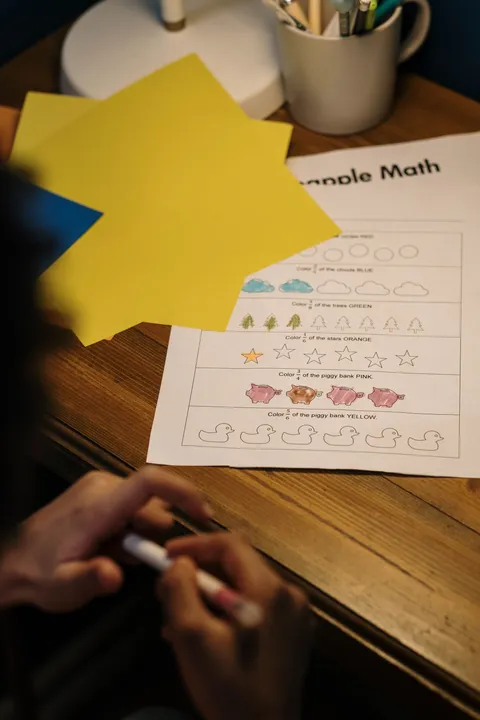
- Continues a simple AB pattern (red, blue, red, blue, …).
- Starts to notice and make other patterns such as ABC or AAB.
- Sorts objects by color, size or shape and explains the rule.
Practice at home: make patterns with snack pieces, coins of play money or beads. Mix one thing up and ask your child to find the “odd one out.”
7. Early problem solving and reasoning
This is the quiet skill underneath all the others: thinking about why an answer makes sense.
- Explains how they found an answer in their own words.
- Tries another way when the first idea does not work.
- Spots what does not belong in a group.
Practice at home: ask “how did you figure that out?” often, and accept answers that are not perfect. Puzzles, mazes and “what comes next?” games all build this habit.
Turning the checklist into a weekly routine
You do not need a formal program. A light weekly rhythm might look like this:
- Two or three short “math moments” a day built into daily life: counting at snack time, comparing at tidy-up, patterns when getting dressed.
- One short sit-down session a few times a week, around 10 to 15 minutes, with a game or page that focuses on a single skill.
- A quick review of the checklist every month or so, moving a skill from “not yet” to “sometimes” when you see progress.
For more on balancing worksheets with hands-on play, see our guide to kindergarten math and reading worksheets. If you are wondering about skills beyond math, the preschool and kindergarten readiness checklist covers the bigger picture, and getting ready for kindergarten at home offers routines that support learning.
Using a printable workbook
Some families like to keep practice pages together in one place. The Kindergarten Math Workbook: Counting, Numbers, Addition & Subtraction to 10 is a 25-page printable PDF for ages 5 to 6. It includes counting to 10, number matching and count-and-write pages, addition and subtraction on fingers and with pictures, comparing bigger and smaller, shading shapes, spotting the odd one out, connect-the-dots and a final math challenge. It is priced at $3.99.
A workbook works best as a supplement. Print a page or two, let your child work with a pencil, then follow up with a real-object version of the same skill: if the page counted corn, count real beans at the table. If a page feels too easy or too hard, put it aside and come back later.
Safety and common-sense notes
- Counting with small objects such as buttons, beads or coins is for supervised children only. Keep small items away from mouths and from younger siblings.
- Use large, blunt-tipped scissors and child-safe glue for cutting and pasting shapes.
- Watch for frustration. If your child cries or avoids math time, shorten sessions and make them more game-like.
When to talk with the teacher
Children learn at very different rates, and a child who is not yet adding within 10 in the first months of kindergarten is not necessarily behind. Still, it is worth asking your child’s teacher if a skill stays very difficult over a long period, if your child seems unusually anxious about numbers, or if you simply want to know what the classroom is working on. Teachers can tell you what is expected locally and suggest practice that fits.
Bringing it together
A kindergarten math checklist is a map, not a grade. Check skills with real objects first, practice in short and cheerful bursts, celebrate effort, and keep your eye on understanding rather than speed. Over the school year, counting, comparing and small sums usually become familiar, and the checklist will show you how far your child has come.