Thanksgiving worksheets show up everywhere online each November, but not every pack is worth printing. Thanksgiving worksheets for kids work best when a page turns a small skill — counting corn, tracing a leaf, writing one thing you’re thankful for — into something a child wants to finish. A pack that’s just a turkey clip-art border around a repetitive drill is easy to skip.
This guide covers what a good Thanksgiving worksheet pack for ages 4 to 8 should contain, what each page type helps build, how to use printables in short low-pressure sessions before and on the holiday, and how to adapt one pack for siblings of different ages.
What a good Thanksgiving worksheet pack contains
Look for a mix of the following page types rather than many pages of just one kind.
Gratitude and writing. Pages that ask “What am I thankful for?” or invite a child to fill in grateful words or draw a gratitude tree. These pages have no wrong answer, and the point is honest reflection, not correctness.
Coloring. Thanksgiving feast scenes, cornucopias and autumn-color pages give children room to relax and create rather than fill in answers.
Counting and early math. Counting corn, pumpkins or place settings, and simple “count and write” pages, help young children connect a number to what it represents.
Tracing and pre-writing. Tracing leaves or the word “Thankful” builds the pencil control that later handwriting needs. Look for thick, well-spaced lines.
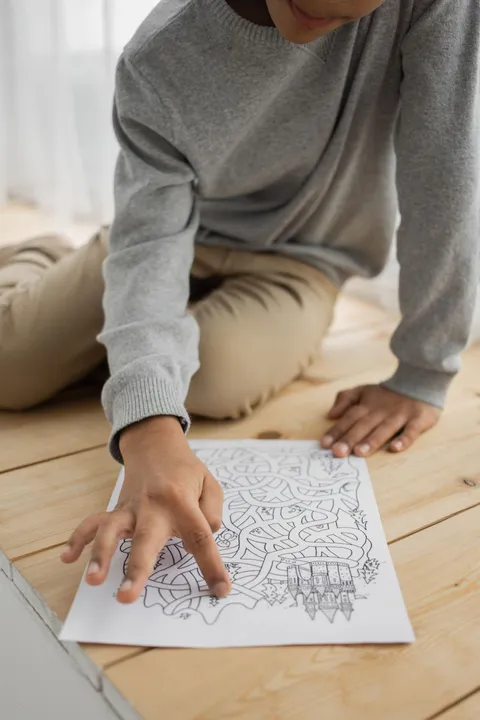
Mazes and paths. A harvest maze or “follow the path” page trains planning and visual attention, and tends to be a page children ask to repeat. For more on this page type generally, see our guide to printable mazes for kids.
Matching and patterns. Thanksgiving matching pairs and “finish the pattern” pages build the habit of noticing what repeats or connects.
Puzzles. A simple crossword or spot-the-difference page with a Thanksgiving word bank gives older children in the 6 to 8 range something to work through independently.
Which skills each page type supports
| Page type | Skill it can support | Typical ages |
|---|---|---|
| Gratitude and writing prompts | Reflection, early sentence building | 4 to 8 |
| Counting corn, pumpkins, place settings | Number sense, one-to-one counting | 4 to 6 |
| Tracing leaves and words | Pencil control, pre-writing | 4 to 6 |
| Mazes and “follow the path” | Visual attention, planning | 4 to 8 |
| Matching and finish-the-pattern | Recognition, prediction | 4 to 7 |
| Simple crossword | Word recall, spelling awareness | 6 to 8 |
A simple way to use printables before and on the holiday
Thanksgiving printables can start well before the day itself and continue through it.
- Start in early November with a page or two a few times a week, rather than saving everything for the day.
- Use gratitude pages across several sittings — one week’s answer often differs from the next, and that’s part of the value.
- Save mazes, puzzles and coloring for Thanksgiving Day itself, when children may need a quiet activity while adults are busy.
- Do one easy page first, then one that stretches your child a little.
- Stop while it’s still enjoyable. Ten minutes of genuine interest beats twenty of pushing through.
Adapting one pack for siblings of different ages
Children in the same family often need different levels from the same pack. A five-year-old may need help writing full words on a gratitude page while an eight-year-old writes independently and moves on to the crossword. Offer the easier page types (coloring, simple counting) to younger siblings and the more demanding ones (crossword, longer writing prompts) to older ones from the same pack, rather than assuming everyone needs the same page.
A ready-made option: the Thanksgiving & Fall Activity Book
If gathering pages from several sources feels like more work than it’s worth, Thanksgiving & Fall Activity Book for Kids: Gratitude Pages, Puzzles & Coloring is a 25-page printable PDF for ages 4 to 8. According to its product page, it includes:
- Gratitude pages: “What Am I Thankful For?”, “Grateful Words” and “My Gratitude Tree”
- Coloring pages: Thanksgiving feast, cornucopia, autumn colors and a color-by-number page
- A harvest maze and “follow the path” page
- Spot the difference, connect the dots, finish the pattern and Thanksgiving matching
- Counting pages: count and write, count the corn, and a pumpkin patch page
- Tracing pages for leaves and the word “Thankful”
- A family feast drawing page, autumn animals and a Thanksgiving crossword
Because it’s a single PDF, you can print only what you need for a given week and reprint a favorite page for a younger sibling. If you’d like more general guidance on choosing a printable activity book beyond the Thanksgiving theme, see printable activity books for kids, and for a look at reading and math worksheets for slightly older children, kindergarten math and reading worksheets is a useful next stop.
Quick tips for printing and prep
- Print a test page first to check the lines and pictures are clear at your printer’s usual settings.
- Use draft mode for coloring pages to save ink; it’s typically fine for line art.
- Keep a folder for finished pages so your child can see their own progress across the month.
- Offer a pencil for puzzles so mistakes are easy to erase, and crayons or markers for coloring.
Safety and comfort notes
Worksheets are low-risk overall, but a few habits help younger children specifically:
- Use non-toxic crayons, markers and glue, especially with children who may still put things in their mouths.
- Supervise scissors closely for any cut-and-paste page.
- Take a short break every 10 to 15 minutes and stop if your child seems tired or frustrated — there’s no benefit in finishing a page under protest.
Bringing it together
The best Thanksgiving worksheets are the ones your child wants to pick up again. Favor variety over repetition, treat gratitude pages as reflection rather than a test, and keep sessions short enough that pencils stay fun through the whole month. Whether you print single pages or use a complete activity book, a little daily practice in November is an easy way to build a small routine around the holiday.