“Puzzle book” covers a wider range of activities than it might sound like. A mixed brain games workbook, a hidden pictures scene, and a seek-and-find activity book all count as puzzle books, but they ask a child to use their attention in genuinely different ways. Knowing what each format actually trains — and where it tends to work best — makes it much easier to pick one that fits your child, rather than choosing based on the cover alone.
What “printable puzzle book” actually covers
Printable puzzle books generally fall into a few recognizable formats. Brain games and logic-style books mix several puzzle types in one workbook — mazes, matching games, pattern recognition, spot-the-difference, and similar — each exercising a different kind of reasoning. Hidden pictures and seek-and-find books use one format throughout: a detailed illustrated scene with a list of items to locate within it. Both are puzzle formats in the broad sense, but the actual task a child is doing on the page looks quite different from one to the other.
What brain games and mixed puzzle books are good for
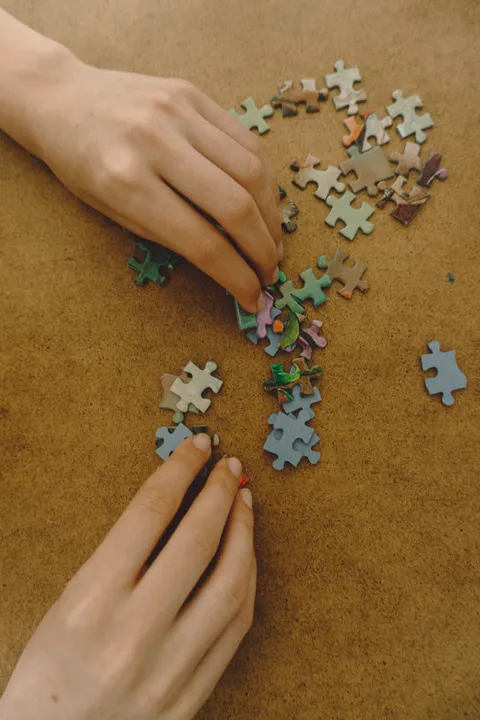
A mixed puzzle book asks a child to switch between different kinds of thinking from one page to the next — following a path in a maze, spotting a pattern, matching pairs, working through a logic challenge. That variety is the format’s biggest strength: it keeps a longer session from feeling repetitive, since a child who tires of one puzzle type can move to a different one within the same book. It also gives a broader picture of which specific puzzle types a child gravitates toward or finds difficult, since several are represented side by side.
What hidden pictures and seek-and-find books are good for
A hidden pictures or seek-and-find page works differently: the task stays the same throughout — carefully scanning an illustrated scene to locate a list of specific items — while the scene itself changes each time. This makes the format easier to pick up without any spoken instructions, since the goal is visually obvious from the page itself. It’s also a genuinely different mental skill from a logic puzzle: sustained visual attention and scanning, rather than sequencing or pattern-based reasoning. Many children find this format calming in a way a timed or answer-based puzzle isn’t, since there’s no wrong path to take — just steady looking.
How to choose between the two formats
A few questions help narrow this down for a specific child:
- Does your child prefer variety or a steady, repeatable task? A mixed brain games book suits a child who likes switching between puzzle types; a hidden pictures book suits one who settles into a single, repeatable kind of task more easily.
- How independently can your child follow written instructions? A seek-and-find scene is largely self-explanatory from the picture and item list alone, which can make it a more approachable starting point for a younger or less confident reader than a book that mixes several instruction-based puzzle types.
- Are you looking for active problem-solving or a calmer, quieter activity? Logic and matching puzzles tend to feel more active and goal-directed; hidden pictures scenes tend to feel slower and more meditative, closer in spirit to a quiet-time activity than a challenge to beat.
Three books, two different formats
Brain Games for Kids — Printable Activity Workbook is a mixed puzzle workbook for ages 4–10, covering puzzles, mazes, matching games, pattern recognition, spot-the-difference, and logic challenges in one printable PDF — a good fit for a child who wants variety across a session.
Hidden Pictures & Seek-and-Find — Printable Activity Book for Kids is built for ages 4–10 around the seek-and-find format specifically, giving a child a steady, repeatable task across a set of illustrated scenes.
Cute Critters: Hidden Pictures & Seek-and-Find Activity Book for Kids uses the same seek-and-find format, built around cute critter illustrations for families who want that particular theme rather than a general scene-based book.
Between the two hidden pictures options, the choice mostly comes down to theme — critter-focused artwork versus a more general seek-and-find set — since both use the same core format.
How this fits alongside other skill-practice printables
Puzzle books are one part of a broader printable skill-practice rotation. Skill-Practice Printable Workbooks for Kids, by Age and Skill covers other formats built around logic, time management, and geography, and Logic and Problem-Solving Activities for Kids: A Practical Guide goes deeper on the reasoning skills a mixed puzzle book like Brain Games for Kids exercises. For families keeping a screen-free activity or puzzle book on hand for rainy days and travel rather than structured skill practice, Screen-Free Puzzle and Activity Books Worth Keeping on Hand covers that different use case in more depth.
Bringing it together
Choosing a printable puzzle book comes down to matching the format to the kind of thinking and attention you’re looking for — variety and active problem-solving from a mixed brain games book, or a calmer, repeatable task from a hidden pictures or seek-and-find book. How to Build a Simple At-Home Skill-Practice Routine for Kids covers how to fit any of these into a short, sustainable weekly rhythm once you’ve picked one.
Frequently asked questions
What’s the actual difference between a brain games book and a hidden pictures book?
A brain games book mixes puzzle types — mazes, matching, pattern recognition, logic challenges — that each work a different kind of thinking. A hidden pictures or seek-and-find book uses one consistent format throughout: scanning a detailed scene to find specific items. They’re both puzzle formats, but they ask a child to think in different ways.
Which format is better for a younger child?
A seek-and-find or hidden pictures page tends to be an easier entry point for a younger child, since the task itself — find the item in the picture — is simple to understand without any written instructions. A mixed brain games book, with its variety of puzzle types, often suits a child who’s ready to follow a few different kinds of instructions in one sitting.
Can these printable puzzle books be reused, or are they one-time activities?
Some pages can be revisited, especially hidden pictures scenes where a child may not remember every item’s location after a few weeks. Logic and maze-style pages are generally more one-and-done, since the answer is easy to recall once solved. Printing a fresh copy is a simple way to reuse a favorite page later.