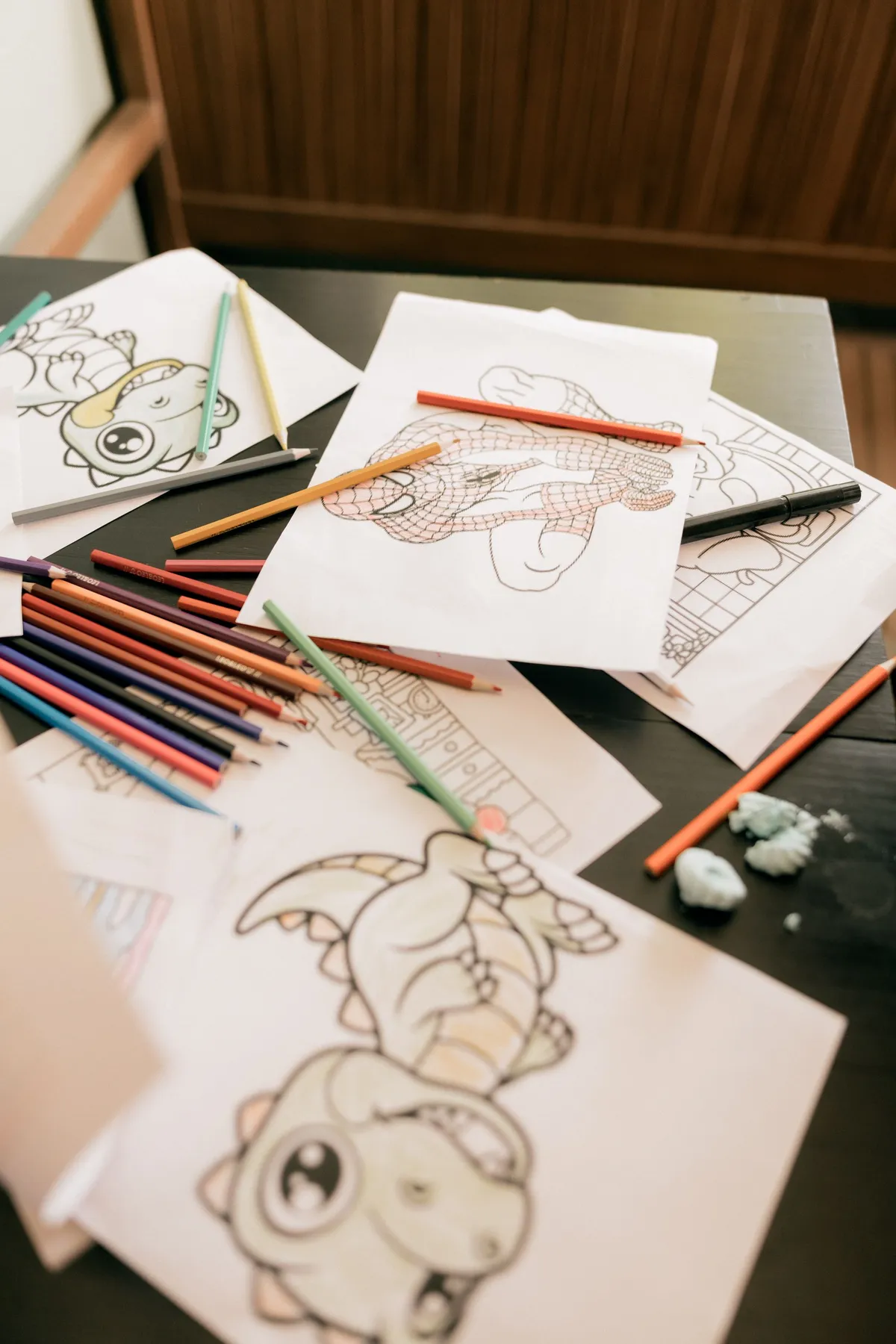
A good screen-free activity book earns a permanent spot in a bag or a kitchen drawer for the same reason a favorite toy does: it’s ready the moment it’s needed, without setup, supervision, or a trip to find supplies. Puzzle and activity books in particular are worth understanding as their own category — distinct from a single coloring page or a one-off printable — because a well-built one can cover a much wider range of moments than any single activity can.
Rainy days and long stretches at home
A rainy afternoon usually calls for more than one activity to fill it. A mixed activity book — one with several different types of puzzles and games inside rather than just one — gives a child room to move between tasks as attention shifts, without needing a parent to plan the next thing. Books that mix puzzle types (mazes, matching games, pattern recognition, word searches, and similar) tend to hold up better over a full afternoon than a single-format book, simply because there’s more variety to draw on before anything starts to feel repetitive.
Road trips, flights, and waiting rooms
Travel calls for the opposite approach: something small, self-contained, and quick to put down. A maze-only book is a good fit here specifically because each maze is its own short task with a clear finish line — a child can complete one before the car stops for gas, without losing their place in a longer project. Screen-Free Travel and Car Activities for Kids covers the rest of what makes a travel activity work in a small, moving space; a compact puzzle book fits the same criteria.
Quiet time and calm, focused moments
Puzzle-style activities are also useful outside of “keeping busy” — a maze, a logic puzzle, or a matching game gives a child something to focus on quietly, without much talking or movement, which makes this format a reasonable option for a wind-down stretch before naptime or bed. It’s a different kind of quiet activity from a coloring page, since it usually has a clear goal or a “finished” state, which some children find more satisfying to settle into than an open-ended one.
An everyday screen-free backup
Beyond specific situations, having one puzzle or activity book somewhere accessible — a car door pocket, a kitchen drawer, a backpack — means there’s always a screen-free option on hand without having to remember to bring one. Screen-Free Boredom Busters for Kids and Rainy Day Activities for Kids, by Age both cover no-materials-needed activity ideas for the same kind of moment; a printed activity book is simply a version of the same idea that requires no improvising once it’s printed and on hand.
Three books, three different strengths
Not every printable activity book is built for the same moment, and it’s worth knowing how they actually differ before picking one.
The Ultimate Kids’ Activity Book — 25 Screen-Free Games & Puzzles is the broadest of the three: a mixed PDF workbook for ages 4–8 with puzzles, mazes, matching games, pattern recognition, spot-the-difference, word searches, connect-the-dots, counting games, and drawing prompts. Its size and variety make it the strongest fit for a rainy afternoon or a general at-home boredom backup, since there’s enough range inside to move between activity types without repeating.
Maze Mania for Kids — 25 Epic Mazes from Easy to Hard takes the opposite approach on purpose: it’s a single-format book of 25 mazes for ages 4–10, arranged from easy to hard across a handful of themes, with a solutions page included. Because each maze is a short, self-contained task, it’s the pick best suited to travel or a quick break, rather than a long sit-down session.
Brain Games for Kids — Printable Activity Workbook sits between the two: a smaller mixed workbook for ages 4–10 covering puzzles, mazes, matching games, pattern recognition, spot-the-difference, and logic challenges, at a lower price than the larger activity book. It’s a reasonable lighter-weight option for a family trying the format for the first time, or one that wants a mixed book without the size of the full 25-activity collection.
Bringing it together
None of these need to replace the screen-free ideas already covered elsewhere on this site — they’re simply a version of the same idea that comes pre-planned and ready to print. Kids Activities at Home: The Complete Guide covers the rest of the cluster this fits into, from indoor play by age to travel-specific ideas, and Indoor Activities for 4 Year Olds at Home is a good next stop for age-specific ideas beyond puzzle books alone.
Frequently asked questions
Are activity books actually different from just printing random free worksheets?
The main difference is curation: a printed activity book is built around a consistent theme or format with a defined range of difficulty, and often includes a solutions page, rather than being a random mix of one-off pages. That makes it easier to hand a child one book and let them work through it without you needing to plan or vet anything as you go.
Which is better for a car ride versus a rainy day at home?
A single, self-contained task suits a car ride better than a big mixed collection does — one maze can be finished before the next stop, without needing a flat surface or much time. A rainy afternoon at home has more room for a bigger, more varied book with several activity types to move between.
Do I need more than one of these, or is one enough?
One is enough for most families to start. The right pick usually comes down to which moment you’re solving for most often — a broad mixed book for regular at-home boredom, a maze-only book for travel and quick breaks, or a lighter, lower-cost mixed book if you just want to try the format first.