Two pictures sit side by side. They look identical, but they are not. Somewhere in the second one, a flower is missing, a sleeve has changed color or a fish has lost a stripe. Finding what changed is the whole game, and children from about three years old tend to love the feeling of “I found it!”
This guide explains how spot-the-difference puzzles for kids work, what they practice, how many differences to expect at each age and how to make your own with things you already have. It also covers how to help a child who gets stuck without simply pointing at the answer.
What children practice with spot-the-difference puzzles
A spot-the-difference page looks like a simple game, but it asks a child to do several things at once. Without turning it into a lesson, here is what is typically happening while they search:
- Focused attention. Staying with one task for a few minutes is a skill that grows with practice.
- Visual comparison. The child holds one detail in mind and checks it against the other picture.
- Visual memory. Many children glance at one picture, then the other, and rely on what they remember seeing.
- Language. Saying “the cat has no tail here” is a small exercise in describing position, color and shape.
- Patience and persistence. Some differences are tricky. Sticking with the search, and being allowed to struggle a little, is part of the value.
None of this is a guarantee of a particular outcome, and every child develops at their own pace. Treat the puzzle as a pleasant way to practice looking closely, not as a test.
Age guide: what to expect from 3 to 8
Use these ranges as a starting point and adjust to your child. A child who is new to puzzles can begin one level lower, and a child who zooms through them can move up.
Ages 3 to 4: a few big changes. Look for two or three differences in a simple picture with large objects: an animal with a missing ear, a ball that changes color, a cup that is present in one picture and gone in the other. Sit beside your child and let them point. Celebrate every find.
Ages 4 to 5: four to six differences. Pictures can include more objects, but keep the scene uncluttered. Children this age often begin to look at one object at a time and compare it, which is exactly the habit that makes puzzles easier.
Ages 5 to 6: six to eight differences. Differences can be smaller, such as the number of buttons, a pattern on a shirt or the direction something faces. Many children this age enjoy circling the differences with a crayon or pencil.
Ages 7 to 8: eight or more, with busier scenes. Older children can manage crowded scenes, black-and-white drawings and subtle changes. A gentle time challenge, or a puzzle they make themselves, keeps it interesting.
A simple search routine that helps
Many children stare at both pictures at once and feel overwhelmed. A routine gives them somewhere to start. Try one of these and let your child pick the one that suits them:
- Scan in rows. Draw an imaginary line across the top of both pictures and compare what is in each row, then move down.
- Object by object. Pick one object, such as the tree, and check it in both pictures: color, size, number of parts, position. Then move to the next object.
- Count and compare. Count the flowers, windows or birds in each picture. Different totals reveal a difference right away.
- Cover and reveal. Use a sheet of paper to cover most of each picture so only one small area shows. Slide it along and compare each section.
Practicing the routine out loud (“I’m looking at the roof. Roof, same. Now the door…”) turns a hunt into a method the child can reuse.
How to help without giving the answer
Children learn more from finding the difference themselves, so hints should be small steps rather than the solution. A few ideas, from lightest to strongest:
- “Take another look at the top half of the picture.”
- “Check the animals. Are they all the same?”
- “Count the leaves on the tree in each picture.”
- Point to the general area, but let your child find the exact detail.
If your child is close to giving up, it is fine to reveal one difference and invite them to carry on. Ending on a success matters more than finishing every puzzle. A page can also be left on the table and revisited later; a fresh look often reveals what tired eyes missed.
Make your own spot-the-difference puzzles
Homemade puzzles are free, personal and easy to tune to your child’s level.
Method 1: photocopy and change.
- Draw a simple scene on paper with a pencil, or use a coloring page.
- Photocopy or scan and print it so you have two identical copies.
- On one copy, erase or cover details with correction tape and redraw them differently: add a hat, remove a cloud, change the number of stripes.
- Mark the differences on a separate answer sheet.
Method 2: toy-table photos.
- Arrange a few toys or household objects on a plain table.
- Take a photo.
- Move, remove or swap two or three items and take a second photo from exactly the same spot.
- Print the two photos side by side, or show them on a screen together for a short time.
Method 3: live version, no paper at all. One person arranges a small scene, the other looks for ten seconds and then closes their eyes. The first person changes one thing, and the second person opens their eyes and finds it. Swap roles. This works well in the car or at a restaurant table, where small toys and napkins are enough.
Ways to vary the game
Once your child knows the basic idea, small twists keep it fresh:
- Race the clock gently. Use a kitchen timer for older children, with the aim of beating their own time rather than anyone else’s.
- Take turns being the maker. Children often find that making a puzzle teaches them more about how differences work than solving one.
- Add a story. Ask your child to describe what changed as if telling a story: “In the first picture the dog is sleeping, in the second he is awake.”
- Combine with coloring. After finding the differences, color each picture the way your child imagines it.
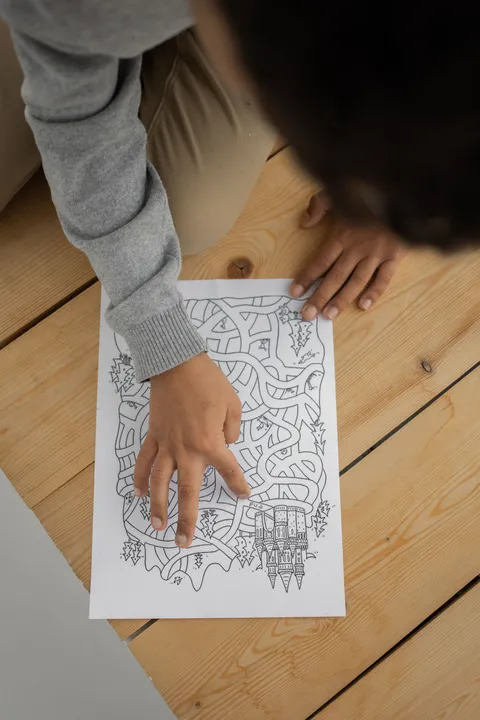
- Mix with other puzzles. Alternate with a maze or a seek-and-find page so the activity does not feel repetitive. Our guide to hidden pictures printables and the roundup of printable puzzles with answers are good places to look, and maze activities make a nice change of pace.
Printable puzzle books to keep on hand
Making puzzles by hand is satisfying, but a ready-made set is handy for waiting rooms, travel days and rainy afternoons. Our Hidden Pictures & Seek-and-Find Printable Activity Book is a printable book for ages 4 to 10, which makes it a gentle next step when your child enjoys looking for details. If your child is drawn to animals, the Cute Critters: Hidden Pictures & Seek-and-Find Activity Book is a PDF with critter illustrations to search and spot. Both are printable, so you can print a page, hand it over with a pencil and put the rest away until next time.
Quick tips for a calm puzzle session
- Pick a quiet moment with good light, and sit beside your child rather than across from them.
- Start with an easy puzzle so the first minute feels like a win.
- Let your child choose between two puzzles; choice builds interest.
- Keep sessions short, often five to ten minutes is plenty for younger children.
- Praise effort (“You kept looking until you found it”) rather than speed.
- Stop while it is still fun, and leave the page out to revisit later.
Spot-the-difference puzzles reward looking slowly and carefully, which is something children rarely get to do in a busy day. Whether you print a page, make one from a photo or play the live version at the dinner table, a few quiet minutes of “what changed?” can turn into a small family ritual that children ask for again and again.