The kids’ table on Thanksgiving Day usually needs something to fill the gap between arriving and eating. Thanksgiving crossword and puzzles for kids are a simple, low-mess way to do that: quiet enough for a busy kitchen, quick enough to finish before dinner, and easy to adapt for children of different ages at the same table.
This guide covers puzzle types worth having on hand, how to set up a 15-minute puzzle corner, and how to build your own simple crossword if you would rather make one than search for a printable.
Why puzzles work well for a Thanksgiving gathering
Puzzles are naturally self-paced. A child can work alone, with a sibling, or with an adult stepping in and out between kitchen tasks, and there is no need to referee turns the way a group game might require. A page also travels well: it can move from the kids’ table to a quiet corner and back without losing anything, which matters on a day when the room fills up and empties out again.
Picture crossword
A picture crossword replaces some or all of the written clues with a small drawing, which lets younger children join in even before they read clue sentences confidently. Use short, common words: turkey, corn, pumpkin, leaf, pie, family, thankful. A word bank at the bottom of the page, listing every answer out of order, turns the puzzle into a matching-and-spelling task rather than a blank-page guess.
Best for: ages 5 to 8, depending on word length and whether clues are pictures or short sentences.
Harvest maze
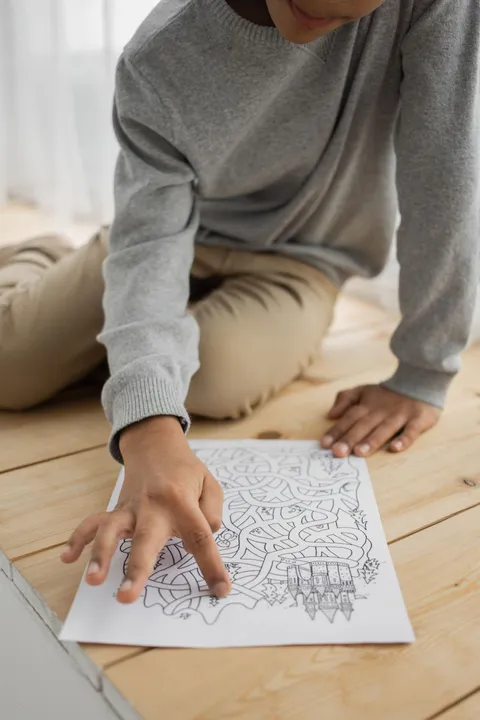
A maze with a Thanksgiving theme, guiding a turkey to a pumpkin patch or a family to the dinner table, builds planning and pencil control the same way any maze does. For more on choosing maze difficulty by age, see our guide to printable mazes for kids.
Best for: ages 4 to 8; choose a wider path with fewer turns for younger children.
Spot the difference
Two nearly identical Thanksgiving scenes, a set table or a harvest picture, with five to ten small differences hidden between them, trains visual attention in a way that holds a child’s focus without requiring reading. This page type also works well for children still learning English or younger siblings who cannot yet do a crossword.
Best for: ages 4 to 9, with more and smaller differences for older children.
Connect the dots and finish the pattern
Connect-the-dots pages that reveal a turkey or a pumpkin, and pattern pages that ask a child to continue a repeating sequence of leaves or shapes, are good for the youngest guests at the table. They need only a pencil and a few minutes, and there is no way to get a “wrong” answer that causes frustration.
Best for: ages 3 to 6.
A simple “who am I” riddle page
Write three or four short clues, one line each, that describe a Thanksgiving object or character without naming it, and ask the child to guess and draw or write the answer. For example: “I am orange and round, and pie is made from me. Who am I?” (a pumpkin). This needs no printing at all and can be written on the spot with a pencil and paper.
Best for: ages 5 to 9, and a good option if nothing is printed yet.
Setting up a 15-minute puzzle corner
- Pick a small table or clipboard station away from the kitchen and hot dishes.
- Offer 3 to 4 puzzle types, not just one, so children can choose what interests them and move on if one feels too hard.
- Put out pencils with erasers, not pens, so mistakes are easy to fix without frustration.
- Mix difficulty if children of different ages are at the table: a connect-the-dots page next to a full crossword lets each child work at their own level.
- Let an older child “help” a younger one with a puzzle; explaining a clue to someone else is its own kind of practice.
How to write a simple Thanksgiving crossword at home
You do not need software to make a basic crossword.
- Choose 6 to 8 short, familiar words that share some letters, such as turkey, corn, pie, leaf, family and thankful.
- Find two words that share a letter and write them crossing each other on graph paper or a blank grid.
- Add the remaining words one at a time, connecting each to a letter already on the grid where possible.
- Number the first square of each word in order, across then down.
- Write one clue per word, either a picture, a simple sentence (“Something you eat pie made from” for pumpkin), or the definition itself for older children.
- List all the words in a word bank below the grid so children can match spelling rather than recall it from memory.
This takes about ten minutes and can be resized to any age by adjusting word length and clue difficulty.
A ready-made option
If you would rather not gather or draw puzzles from scratch, the Thanksgiving & Fall Activity Book for Kids is a 25-page printable PDF for ages 4 to 8 that includes a Thanksgiving crossword along with a harvest maze, spot the difference, connect the dots, finish the pattern and Thanksgiving matching pages, plus gratitude and coloring pages. Because it is one PDF, you can print just the puzzle pages for the kids’ table and save the rest for another day. For a broader look at what makes a good Thanksgiving worksheet pack overall, see our guide to Thanksgiving worksheets for kids.
Printing and prep tips
- Print a few extra copies of the crossword and spot-the-difference pages; children often want to try again or compare answers with a sibling.
- Keep an answer key nearby for an adult to check quietly, rather than posting it where children can see it early.
- Use a clipboard for children without a stable table surface, common if seating spills into a living room.
Safety and comfort notes
Puzzle pages are low-risk, but a few small habits help at a busy gathering:
- Keep scissors away from young children if any page involves cutting.
- Use pencils rather than pens for anyone still learning to write, since mistakes are part of learning.
- Watch for a child getting frustrated rather than engaged, and switch to an easier puzzle type instead of pushing through.
Bringing it together
A short stack of varied puzzles, a crossword, a maze, a spot-the-difference page and a few riddles, can occupy children happily while the rest of the day comes together around them. Keep the corner low-pressure, offer a range of difficulty, and do not be afraid to write your own crossword by hand if nothing printed is on hand.