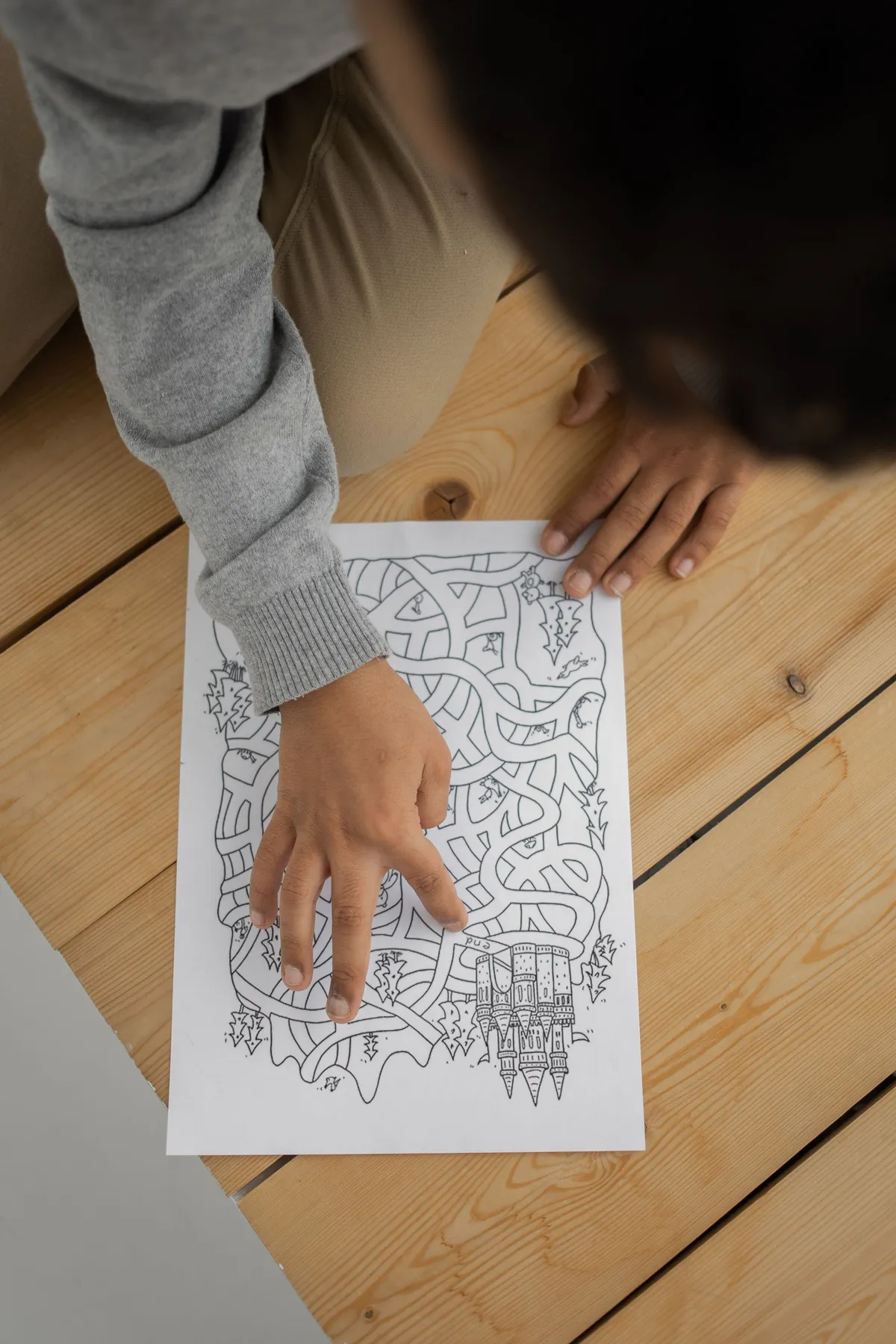
A maze looks like a simple line puzzle, but it holds a child’s attention in a way that’s worth understanding rather than just taking for granted. Tracing a path from start to finish, backing out of a dead end, and trying again asks for a specific kind of patient, focused thinking — and it does it through a task a child actually wants to finish, not one they’re told is good for them.
What a maze actually asks a child to do
Solving a maze isn’t just drawing a line — it involves looking ahead before committing to a path, noticing when a route dead-ends, backtracking without frustration, and holding the overall goal in mind while working through the details step by step. That combination of planning, adjusting, and following through is a genuinely useful kind of thinking, and a maze packages it into a task with a clear, satisfying finish line: a completed path from start to end.
Why maze activities are worth the table time
A few things make mazes a particularly good fit for a short stretch of table time:
- They’re self-contained. A single maze has a clear beginning and end, so a child can finish one in a few minutes without needing to stop mid-task or come back to it later.
- They reward patience without punishing mistakes. A wrong turn just means backtracking a little, not starting over completely — a gentler way to practice tolerating a mistake than many other puzzle formats.
- They scale naturally with difficulty. A simple maze with one or two turns and a wide path suits a younger child, while a longer maze with several dead ends and a narrower path challenges an older one — the same basic format works across a wide age range.
- They don’t require much explanation. The goal is visible on the page itself, which makes mazes an easy activity to hand over with very little setup or instruction.
Choosing and introducing mazes by age
Matching a maze’s difficulty to a child’s current stage makes the difference between an activity that holds their attention and one that gets abandoned halfway through.
- Around ages 3–4: Look for mazes with a single wide path, minimal branching, and only one or two dead ends. The goal at this stage is building comfort with the format, not challenge.
- Around ages 5–7: Mazes with a few more turns and dead ends work well here, since a child at this age can typically hold a simple plan in mind and adjust when a path doesn’t pan out.
- Around ages 8–10: Longer, more complex mazes with multiple dead ends and a narrower path suit a child who’s had practice with the simpler versions and is ready for a longer, more demanding task.
Introducing a new, harder maze format tends to go more smoothly with a little support the first time or two — sitting nearby, talking through the strategy out loud, and letting your child lead once the idea clicks.
When mazes work especially well
Mazes are useful well beyond a single sit-down activity. They’re a natural fit for quiet table time — the kind of short, self-directed stretch after a meal or during a slower part of the day where a child wants something to do without much setup. They also travel unusually well: a single maze is compact, needs only a pencil, and can be finished before the next stop on a drive or during a short wait, which makes them a genuinely good option for the car, a flight, or a waiting room. Screen-Free Travel and Car Activities for Kids covers more of what makes an activity work well in that kind of small, moving space — a maze fits the same criteria closely.
How mazes fit alongside other kinds of problem-solving practice
A maze is one specific format within a broader category of problem-solving and logic activities. Logic and Problem-Solving Activities for Kids: A Practical Guide covers other formats — pattern recognition, sorting, sequencing — that build a related but distinct set of reasoning skills, and is a good next stop for a family looking to round out a maze habit with other kinds of thinking practice. Tracing a maze path with a pencil also happens to be a reasonable bit of fine motor practice along the way, in the same everyday sense described in Fine Motor Activities for Preschoolers, even though that isn’t the main point of doing one.
Where Maze Mania for Kids fits
For a family that wants a ready-made set rather than sketching mazes by hand, Maze Mania for Kids — 25 Epic Mazes from Easy to Hard is a printable PDF workbook for ages 4–10 with 25 mazes arranged across easy, medium, and hard difficulty, built around themes like jungle, space, and underwater. Its progressive difficulty makes it easy to start a child on the wider, simpler mazes and move toward the harder ones as they get more comfortable with the format, and it includes a solutions page for checking work along the way.
Bringing it together
A maze is a small, self-contained task that happens to build genuinely useful thinking skills along the way — worth a spot in a regular activity rotation, not just an occasional distraction. Kids Activities at Home: The Complete Guide ties this together with the rest of what’s on this site, from indoor play by age to calm-down strategies for bigger moments.
Frequently asked questions
What age can a child start doing mazes?
Very simple, large-path mazes can work from around age 3 to 4, once a child can hold a crayon or pencil with some control. Mazes with more turns, dead ends, and longer paths tend to suit children from around 5 through 10, with difficulty scaling up as a child gets more comfortable with the format.
Do mazes actually help with anything, or are they just a time-filler?
They’re genuinely both. A maze gives a child a self-contained task with a clear goal, which is naturally engaging, while also involving planning ahead, adjusting after a wrong turn, and steady hand control along the way. It doesn’t need to be framed as a lesson for those things to happen.
How do I introduce mazes to a child who’s never tried one?
Start with a maze that has a wide, simple path and only one or two dead ends, and sit with your child for the first one or two. Talking through the strategy out loud — “let’s see where this path goes” — helps more than handing over a book and walking away, especially the first few times.