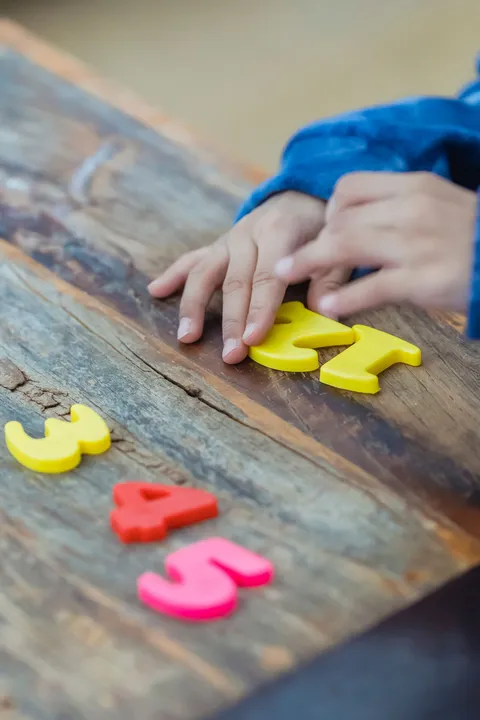
Counting real objects, moving them around and watching a group grow or shrink is how most young children first understand what numbers mean. Halloween is a good excuse to swap plain counters for pumpkin seeds, paper bats and small toy spiders, which turns Halloween math activities for kids into something closer to play than a worksheet.
The eight ideas below use candy-free materials, move from counting to simple addition and subtraction, and each includes a note on how it connects to a printable page. Most take under fifteen minutes and use things you likely already have.
1. Pumpkin seed counting jars (ages 4 and up)
You need: pumpkin seeds (real, dried, or paper cutouts), small clear cups, a marker.
How to play: Write a number from 1 to 10 on each cup. Ask your child to count out that many seeds into each cup. For a group activity, mix up the cups and have children match seeds to numbers as fast as they can.
Why it works: Placing one object at a time while counting out loud is one of the clearest ways young children learn that each number word matches exactly one object, a skill sometimes called one-to-one counting.
Worksheet connection: This is the hands-on version of a “count and match to the number” page, which appears in many kindergarten and Halloween worksheet packs.
2. Sort the spooky bin (ages 3 and up)
You need: a mixed bin of Halloween objects (paper bats, toy spiders, mini pumpkins, buttons), two or three bowls.
How to play: Ask your child to sort the bin by type, color or size into separate bowls, then count how many are in each. Ask “Which bowl has more?” and “How many more?”
Why it works: Sorting before counting helps children notice categories, and comparing group sizes is an early step toward understanding “more than” and “less than”.
Worksheet connection: Sorting pages, where children draw a line from each Halloween item to its matching group, use exactly this skill on paper.
3. Spooky addition with paper bats (ages 5 and up)
You need: paper bat cutouts (or a printed sheet you cut apart), two small plates or hoops.
How to play: Put three bats on one plate and two on another. Ask “How many bats altogether?” and let your child push the plates together and count the total. Repeat with different numbers, and let your child choose the starting amounts for extra ownership.
Why it works: Physically combining two groups before writing a number sentence helps children understand what the ”+” sign actually means, rather than memorizing steps without a picture in mind.
Worksheet connection: This mirrors a “spooky addition” page where children add pictures of bats, pumpkins or ghosts and write the total.
4. Halloween subtraction jar (ages 5 and up)
You need: 8 to 10 small toy spiders or buttons in a clear jar, a spoon or tongs.
How to play: Count the spiders together, then take a few out one at a time while your child says the smaller number remaining out loud each time. Ask “How many are left?” before counting to check.
Why it works: Watching a group shrink one item at a time makes subtraction concrete. Tongs or a spoon also add a bit of fine motor practice.
Worksheet connection: This is the hands-on version of a “how many are left” subtraction page, where a picture shows some items crossed out.
5. Costume sorting and graphing (ages 5 and up)
You need: paper or magazine cutouts of costume types (ghost, pumpkin, witch, superhero), a large sheet of paper with columns.
How to play: Sort pictures by costume type into columns to make a simple bar graph, then count and compare: “Which costume has the most? Which has the fewest?”
Why it works: Graphing turns counting into a picture, which helps children compare numbers at a glance rather than only in the abstract.
Worksheet connection: Many Halloween printable packs include a “tally and graph” page that follows the same idea on a smaller scale.
6. Pumpkin patch number line hop (ages 4 and up)
You need: paper pumpkins numbered 1 to 10, taped on the floor in a line.
How to play: Call out a number and have your child hop to it, or call an addition problem (“start on 3, hop 2 more, where do you land?”) for older children. This also works outdoors with sidewalk chalk.
Why it works: Moving the whole body while counting connects number order to physical space, which many young children find easier than counting silently on paper.
Worksheet connection: This is the physical version of a number-line addition or subtraction page.
7. Witch’s cauldron estimation jar (ages 5 and up)
You need: a jar filled with a countable Halloween item (candy corn shapes cut from paper, small pom-poms), paper for guesses.
How to play: Ask your child to guess how many items are in the jar, write the guess down, then count together to check. Talk about whether the guess was close, and why counting by twos or fives might be faster for a big number.
Why it works: Estimating before counting builds number sense, the general feel for whether an amount is big or small, which supports later mental math.
Worksheet connection: Some kindergarten packs include an estimate-then-count page using a similar picture jar.
8. Trick-or-treat bag counting story (ages 5 and up)
You need: two small bags or bowls, counters (paper candies, pom-poms, or plain buttons).
How to play: Tell a short story problem: “You had 4 treats, and a friend gave you 3 more. How many now?” or “You had 8 treats and gave 2 away. How many are left?” Let your child act it out with the counters before answering.
Why it works: Story problems connect math to something a child can picture, which is closer to how math is actually used than a bare number sentence.
Worksheet connection: Word-problem pages in worksheet packs ask the same kind of question in writing; acting it out first usually makes the page easier.
Turning these into a short daily routine
Ten minutes is plenty. A simple pattern that works for many families:
- Pick one hands-on activity from the list above.
- Do it together, talking through what you are counting and why.
- Follow with one matching worksheet page, if you have one, while the idea is fresh.
- Stop while your child is still enjoying it, even if you planned more.
For a broader look at what kindergarten math and reading pages should cover across the year, see our guide to kindergarten math and reading worksheets, and for fine motor practice that pairs well with cutting out paper shapes for these games, see cut-and-paste worksheets for kindergarten.
A printable option for practice pages
If you would like ready-made Halloween counting, sorting and addition and subtraction pages to go with these hands-on activities, Halloween Activity Book for Kids: Coloring, Mazes, Hidden Pictures & Word Games is a 25-page printable PDF for ages 4 to 8. According to its product page, it includes counting, sorting, spooky addition and Halloween subtraction pages, alongside mazes, hidden pictures, word games, tracing and coloring pages. Print only the math pages if that is what you need, or work through the book in order for more variety.
Troubleshooting common sticking points
- My child counts but skips numbers. Slow down and point to each object as you say its number, and try lining objects up in a row rather than a pile.
- My child guesses instead of counting for addition. Go back to acting it out with objects before asking for a written answer; the physical step often needs more repetition than it seems.
- My child loses interest quickly. Shorten the session, use a timer, or turn the activity into a race or a challenge against a sibling or parent.
- The numbers feel too easy or too hard. Adjust the range: use 1 to 5 for a child who is just starting, and 1 to 20 or simple two-digit addition for a child who is ready for more.
Bringing it together
Halloween math activities work best when a real object comes before a written number. Count seeds into jars, sort a spooky bin, add and subtract with paper bats and spiders, and let a printable page follow up once the idea is fresh in your child’s hands and head. None of this needs special equipment, and the same seeds, buttons and paper cutouts can be reused all season, or repurposed for ordinary math practice once Halloween is over.