There’s a particular kind of concentration that appears when a kindergartener holds scissors and a page: tongue out, paper turning, every snip a small victory. Cut and paste worksheets for kindergarten are more than a craft; they’re one of the best ways to combine fine motor practice with real thinking.
Why cut-and-paste matters
- Scissor skills. Cutting requires hand strength, coordination of both hands and a controlled grip. It prepares children for writing.
- Sorting and classifying. “Which animals live on a farm and which live in the jungle?” is a thinking task, not just a craft.
- Sequencing. Arranging pictures in order (first, next, last) builds comprehension.
- Matching. Letters to sounds, numbers to quantities, shapes to names.
- Following directions. Multi-step tasks (cut, choose, paste) build focus and listening.
What scissor progress looks like
Every child develops at a different pace, but a rough progression looks like this:
- Tearing and snipping small edges of paper.
- Cutting a strip in one snip, then several snips.
- Cutting along a straight line.
- Cutting curves and simple shapes.
- Cutting complex shapes and following detailed outlines.
Kindergarteners are often between stages 3 and 5. If cutting is hard, that’s normal; practice matters more than perfection.
Helping children succeed
Check the grip. Scissors should be held with the thumb in the top hole and one or two fingers in the bottom, with the thumb pointing up. A quick reminder: “Thumbs up!”
Use the right scissors. Child-size scissors with sharp enough blades cut paper cleanly; dull ones frustrate children. Spring-loaded scissors help children still building strength.
Choose the right paper. Thin printer paper can crumple; slightly thicker paper is easier to control.
Pre-cut when needed. If cutting is not the point of the activity (for example, sorting practice), cut the pieces beforehand so children can focus on the thinking.
Use bold, dotted lines. Clear lines help children follow the path.
Stay nearby. Supervise all scissor use, especially with younger children.
Cut-and-paste activity ideas
You don’t need special worksheets to start. Here are ideas across subjects:
Sorting
- Animals by habitat: farm, ocean, jungle.
- Foods by group: fruits, vegetables, snacks.
- Clothes by season: summer, winter.
- Things that float and sink.
Early literacy
- Match pictures to beginning sounds.
- Sort pictures under the right letter.
- Build a simple sentence by pasting words in order.
Early math
- Cut out number cards and paste them in order from 1 to 10.
- Match sets of objects to numerals.
- Cut shapes and paste them to build a picture (a house from triangles and squares).
Sequencing
- Cut the pictures showing the steps of planting a seed and paste them in order.
- Arrange a simple daily routine: wake up, brush teeth, breakfast.
How to set up a cut-and-paste activity
- Gather: scissors, glue stick, the worksheet and a tray.
- Show the steps: “First we cut on the lines, then choose where each picture goes, then paste.”
- Let children work at their pace.
- Talk about their choices: “Why did you put the cow there?”
- Clean up together, including scraps.
Glue sticks are tidier than liquid glue. Teach “a little dab will do.”
Adding variety
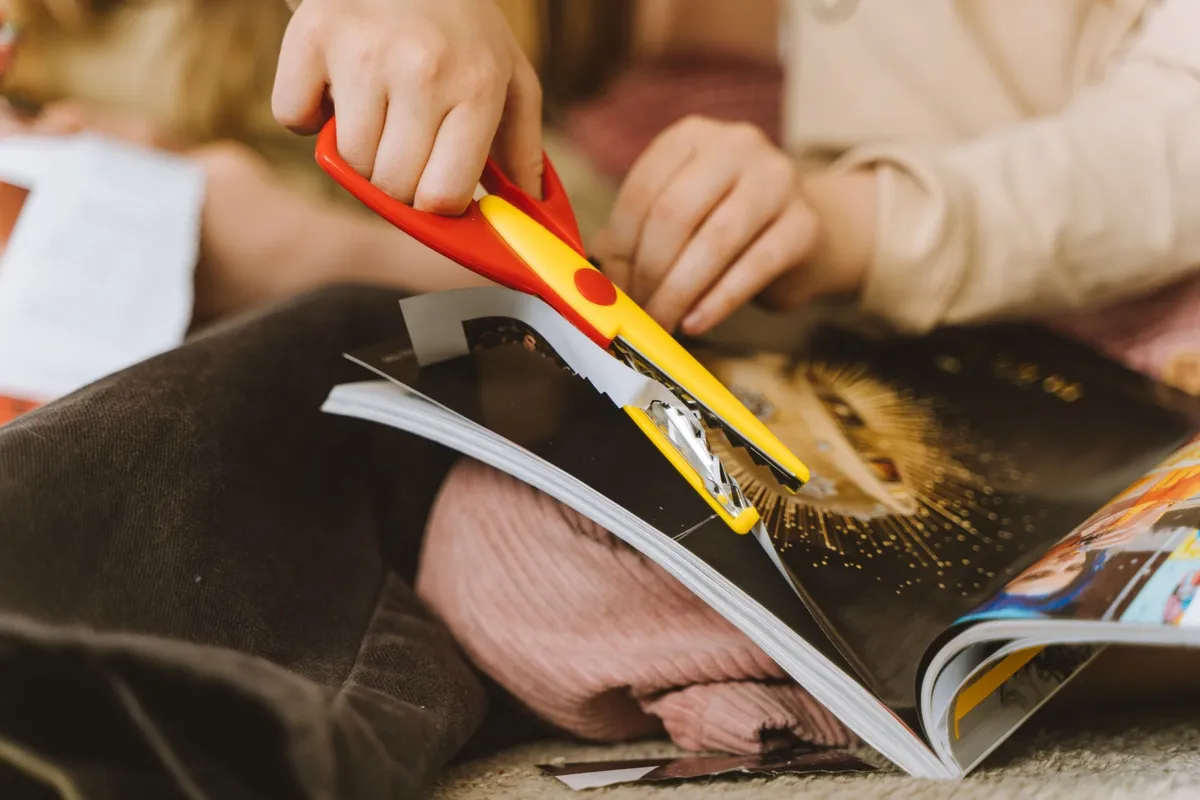
- Use magazines. Children can cut out pictures that start with a certain letter.
- Make your own worksheets. Draw a simple table with two headings and give a stack of pictures to sort.
- Vary the cutting: straight lines, zigzags, curves, shapes.
Printable activity books that include cut-and-paste
If you’d like ready-made pages that cover a range of school-readiness skills, a printable activity book can help. Preschool Skills Busy Book: 100 Printable Activities for School Readiness is a colorful printable with activities for letters, numbers, colors, shapes, counting, tracing, matching and patterns, which you can print in small batches.
For more hand-strengthening ideas, browse our guide to fine motor activities for preschoolers.