Long before a child writes their name, they practice something less glamorous: lines. Pre-writing tracing lines worksheets for preschool are the stepping stones to handwriting, teaching the hand to make the movements that letters are built from. Skipping straight to the alphabet can feel like teaching someone to run before they walk.
This guide shows the stroke order, hand-prep activities, and how to know when your child is ready for letters.
Why pre-writing comes first
Every letter is built from a small set of strokes: straight lines, curves, circles and diagonals. Children who can control these strokes find letter formation much easier, and they’re less likely to become frustrated.
Pre-writing practice also builds:
- Pencil grip and hand strength.
- Hand-eye coordination.
- Left-to-right and top-to-bottom direction, important for reading and writing.
- Focus and patience.
The pre-writing stroke order
Children tend to master shapes in a fairly consistent sequence. A common order:
- Vertical line ( | ) — usually first, drawn top to bottom.
- Horizontal line ( — ) — drawn left to right.
- Circle ( ○ ) — often around age 3.
- Plus or cross ( + ) — combining vertical and horizontal.
- Diagonal lines ( / \ ) — harder to control.
- Square ( □ ) — around age 4.
- Triangle ( △ ) — often the most challenging, around age 5.
Ages are typical ranges; children vary widely. Practice in order and don’t rush. Mastery of one stroke isn’t a prerequisite for enjoying the next.
Types of pre-writing activities
Tracing worksheets
Pages with dotted or thick lines to trace: straight lines, wavy lines, zigzags, loops and spirals. Trace with a finger first, then a crayon or pencil.
Following paths
Draw a car along a road or a snail along a curly path. Storylines help motivation.
Connect the dots
Simple dot-to-dot pages with large dots build controlled movement from point to point.
Big-movement practice
Before paper, practice large strokes: draw lines in sand, paint on a wall with water, write in shaving cream or trace in the air.
Prepare the hands first
Small muscles need warming up. Before tracing, try:
- Play-dough rolling and pinching.
- Tearing paper into pieces.
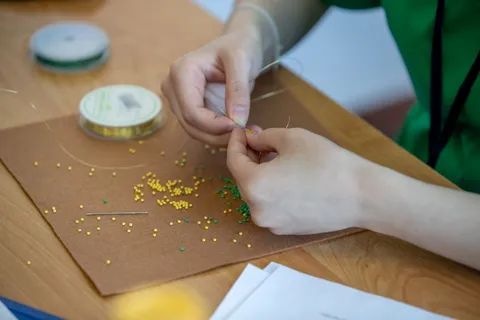
- Threading large beads or pasta (with supervision).
- Using tongs or tweezers to transfer pom-poms.
- Clothespin pinching.
- Sticker peeling.
See our guide to fine motor activities for preschoolers for many more.
Tips for a comfortable grip
- Use short, chunky crayons or broken crayons; they encourage a proper grip.
- Try a vertical surface such as an easel or paper taped to a wall, which strengthens the wrist and shoulder.
- Sit at a comfortable table. Feet on the floor or a footrest and elbows able to rest on the table.
- Don’t over-correct. Grip develops with practice; gentle reminders are enough.
How to run a tracing session
- Keep it short: five to ten minutes for preschoolers.
- Choose a starting dot and show the direction with an arrow or your finger.
- Name the stroke: “Down, down, down.”
- Celebrate effort, not neatness.
- Stop before frustration.
- Repeat often, a few times a week.
Turn lines into play
- Rain and rainbows: draw vertical raindrops and curved rainbows.
- Bumpy road: trace zigzag roads for a toy car.
- Fences and grass: vertical lines make a fence; short lines make grass.
- Spirals: snail shells or lollipops.
When to move to letters
Signs that your child may be ready:
- They can hold a crayon or pencil with fingers.
- They can copy a circle, a cross and a square reasonably.
- They show interest in letters, especially their own name.
Then begin with simple letters that use the strokes they’ve practiced: L, T, I, H, and E are made of straight lines; O and C use circles. See our free printable alphabet tracing pages and number tracing worksheets for the next step.
Ready-made pre-writing pages
If you’d like a printable activity book that includes tracing along with matching, counting and pattern activities, Preschool Skills Busy Book: 100 Printable Activities for School Readiness is designed for school-readiness practice. For younger children ages 2 to 4, My First Learning Busy Book: Letters, Numbers, Colors & Shapes offers 20 pages with tracing, coloring, counting and matching.